TheraHoney Gauze Honey Sheet Dressing Features
- Manuka honey is derived from the pollen and nectar of the Leptospermum scoparium plant in New ZealandÂ
- The honey comb is used only one time, and once harvested, the honey is carefully filtered, irradiated and tested in a laboratory
- TheraHoney Sheet is porous, permitting the passage of exudate into a secondary dressing
Why choose TheraHoney Products?
TheraHoney Sheet contains medical-grade Manuka honey, derived from the pollen and nectar of the Leptospermum Scoparium plant mostly found in New Zealand. The honey comb is used and harvested for once, then it is carefully filtered, irradiated and tested in a laboratory for high efficiency.
- Impact of Manuka Honey on Wound pH: Chronic and non-healing wounds, which mostly have an elevated alkaline environment can be healed by lowering their pH.Use of TheraHoney Sheet made of Manuka honey is associated with a significant decrease in wound pH and wound size reduction.
- Role of Sugar in Autolytic Debridement: 87% high sugar levels in TheraHoney Sheet result in osmotic activity, helping promote autolytic debridement to clear away necrotic tissue, maintain a moist wound environment ideal for healing and reduce wound odor.
- Reduced Necrotic Tissue and Wound Size: Using TheraHoney Sheet, wounds show significant improvement in terms of necrotic tissue and reduction of wound surface over an average of 4 weeks.
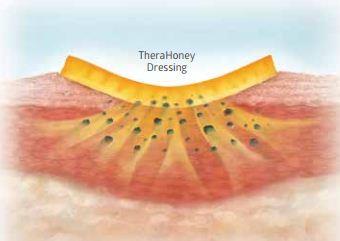
The above provided illustration demonstrates that how the osmotic action of Manuka honey draws exudate from the subcutaneous tissue to the wound surface, removing slough, debris and necrotic tissue.
How To use TheraHoney HD?
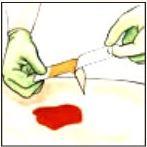 |
1. Remove TheraHoney Sheet from Package. Remove one of the Protective Liners. |
 |
2. Then remove Second Protective Liner. Apply TheraHoney Sheet Dressing directly to wound, either side down. Note: Therahoney Sheet may be cut to size. |
 |
3. Secure TheraHoney Sheet with secondary dressing such as Stratasorb, Optiva Gentle or OptiLock. |
When to use TheraHoney Honey Sheet Dressing?
- Partial and full-thickness woundsÂ
- Pressure injuriesÂ
- Leg ulcers and diabetic foot ulcersÂ
- 1st and 2nd degree burnsÂ
- Minor cuts, minor scalds and burnsÂ
- Surgical and trauma wounds under healthcare professional supervisionÂ
- Minor abrasions and lacerations